Статьи

Опубликован 2026-05-04
Ключевые слова
- ундокай,
- образовательные ценности,
- командная работа,
- инклюзивность,
- дисциплина
- устойчивость,
- школьные фестивали,
- Узбекистан ...Больше
Как цитировать
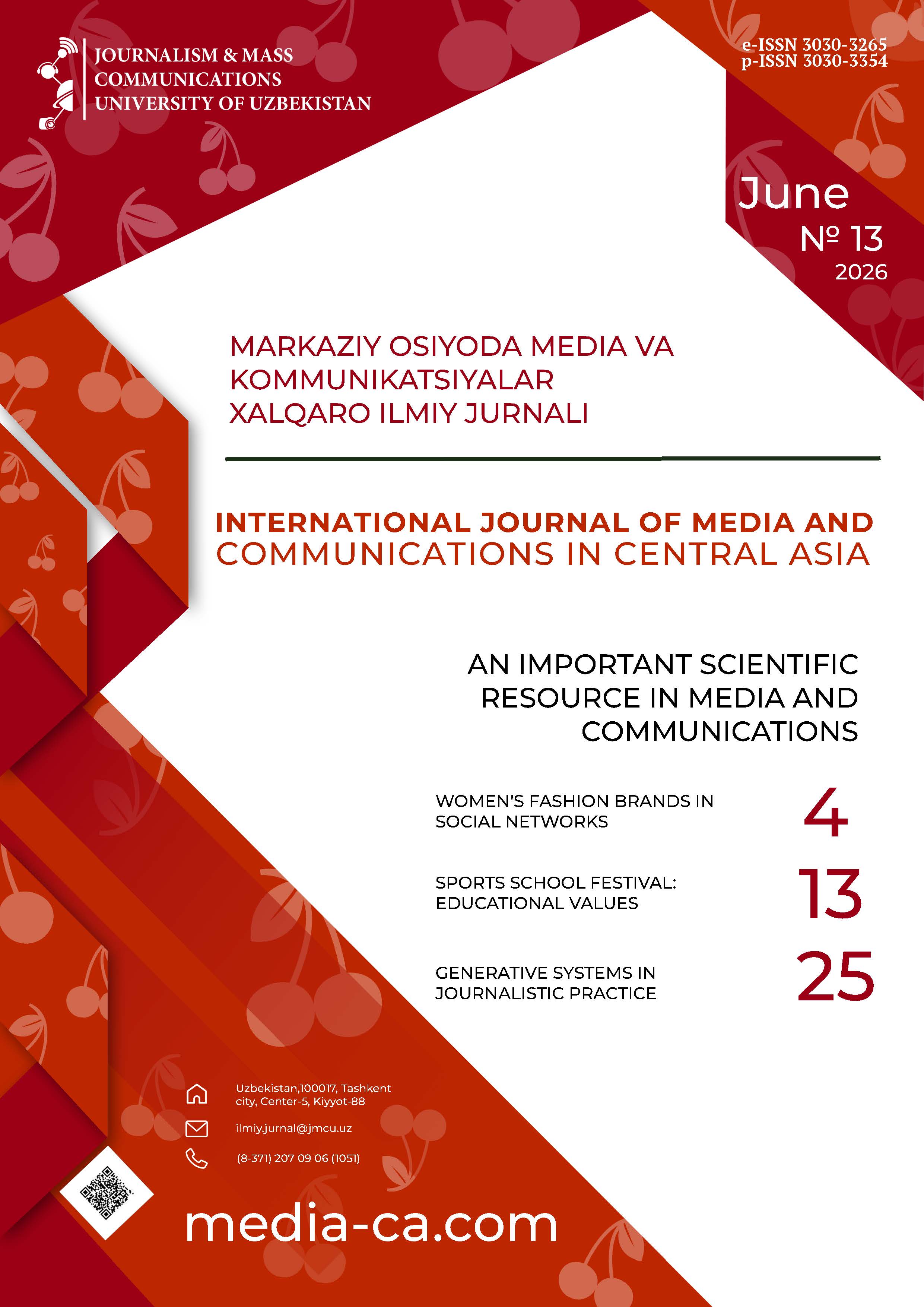
Тургунова, Н. (2026). СПОРТИВНЫЙ ШКОЛЬНЫЙ ФЕСТИВАЛЬ: ОБРАЗОВАТЕЛЬНЫЕ ЦЕННОСТИ. Международный журнал медиа и коммуникаций в Центральной Азии, (13). https://doi.org/10.62499/ijmcc.vi13.301
Аннотация
Исследование рассматривает японский школьный спортивный фестиваль (ундокай) как культурно-образовательную практику, направленную на всестороннее развитие ребёнка — физическое, социальное, эмоциональное и моральное. Работа отвечает на исследовательский вопрос о том, какие образовательные ценности продвигает ундокай, опираясь на анализ источников и результаты анкетирования.
Библиографические ссылки
- Alverson, C. Y., Bell, M., Parra, B., & Wei, L. (2025). Teamwork to Support Students with Disabilities: Challenges, Strategies, and Stages of Group Development Within a Design-Based Research Project. Education Sciences, 15(6), 700. https://doi.org/10.3390/educsci15060700
- Burke, R. S. (2007). Changing times for young minds: Declining class size and shūdan seikatsu ideology in Hokkaido preschools. Retrieved December 13, 2025 from https://www.academia.edu/26352230/Burke_R_S_2014_Independence_An_ethnographic_study_of_e_c_e_in_Japan_and_New_Zealand_Early_Education_56_Spring_Summer
- Campbell CG, Babik I and Crowley SJ (2025) Teaching of transferable teamwork competencies in higher education: development of the TWC Training Protocol©. Front. Educ. 10:1637203. doi: 10.3389/feduc.2025.1637203
- Eshmatov, A. (2025). Opyt zarubezhnykh stran v formirovanii fizicheskikh kachestv shkol’nikov [Foreign experiences in forming the physical abilities of general school students]. International Multidisciplinary Journal for Research & Development, 12(5). https://www.ijmrd.in/index.php/imjrd/article/view/3015
- Gúdel R, Hernández-Correa E, Acebes F and Pajares J (2025) Strategic ownership configurations to foster intangible cultural heritage in Japanese football events. Front. Sports Act. Living 7:1638764. doi: 10.3389/fspor.2025.1638764
- Joubert, Y. T. & De Beer, J. J. (2011). Benefits of team sport for organisations. South African Journal for Research in Sport, Physical Education and Recreation, 33(3), 59–72. Retrieved December 13, 2025 from https://ir.unisa.ac.za/handle/10500/13556
- “Knowledge for Development in Bhutan.” (n.d.). Japanese Overseas Cooperation Volunteers Report, 56–60.
- Kurimoto, E. (2000). Nation-state, empire, and army: The case of Meiji Japan. Senri Ethnological Studies, 51, 95–111.
- McEwan, D. (2019). Relationships of teamwork in sport with group- and individual-level outcomes. Sport, Exercise, and Performance Psychology, 8(2), 151–168. https://doi.org/10.1037/spy0000166
- McEwan, D. (2017). Teamwork in sport (Doctoral dissertation, University of British Columbia). University of British Columbia.
- Menegaldo, F., Coelho Bortoleto, M. A., & Mateu, M. (2023). The artistic-expressive dimension of gymnastics for all. Science of Gymnastics Journal, 15(2), 257-268. https://doi.org/10.52165/sgj.15.2.257-268
- Mühleder, P. (2013). The Japanese school sports day: The socio-cultural role of a ritualistic school event in contemporary Japan. Vienna Journal of East Asian Studies, 4, 67–96. https://doi.org/10.2478/vjeas-2013-0004
- Patel, H., Perry, S., Badu, E. et al. A scoping review of interprofessional education in healthcare: evaluating competency development, educational outcomes and challenges. BMC Med Educ 25, 409 (2025). https://doi.org/10.1186/s12909-025-06969-3
- Saga, N., Nakazawa, A., Esaki, Y., Ueno, K., & Takahashi, K. (2022). Cultural exchange program for youth sport development: A case example of Japan’s sport festival “undokai” in Ecuador. Bulletin of the Faculty of Health and Sport Sciences, University of Tsukuba, 45, 97–106.
- Shiraishi, T. (2022). Investigating Japan’s physical education assistance to other countries. Journal of International Curriculum and Education Studies, 7(1), 1–15.
- Siriphatcharachot, P., Sukkamart, A., Thongkaw, A., Pimdee, P., & Moto, S. (2025). High school student creativity, innovation, and teamwork skills from teacher’s perspective: A second-order confirmatory factor analysis. International Journal of Instruction, 18(1), 39-60. https://doi.org/10.29333/iji.2025.1813a
- Takayama, K., & Okitsu, T. (2024). The “middle way” approach to the EDU-Port Japan. In K. Takayama & T. Okitsu (Eds.), [Book title] (pp. 181–197). Edward Elgar.
- Tamura, R. (1989). Japanese High School Sports Festival (ED316510). ERIC. https://eric.ed.gov/?id=ED316510
- Tamura, R., et al. (1991). Designing the State of Oregon Teaching Certification Program for Japanese. ERIC.
- Tomura, S., Sato, T., Miller, K. E., & Furuta, M. (2024). Japanese elementary classroom teachers’ experiences with parental involvement of immigrants regarding physical education. Education 3–13, 52(2), 185–200. https://doi.org/10.1080/03004279.2022.2114143